Comprehensive Vocabulary Grade 7
5.0 · 4 teacher reviewsFor a multiple-order discount, email penningtonpublishing7@gmail.com.
Program Description
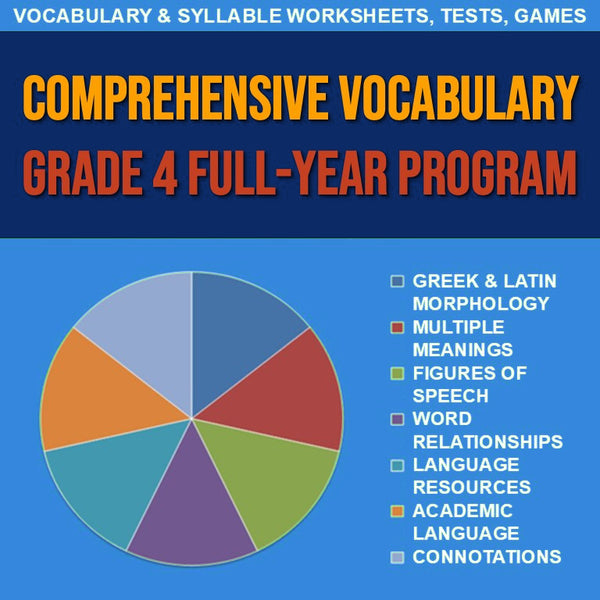
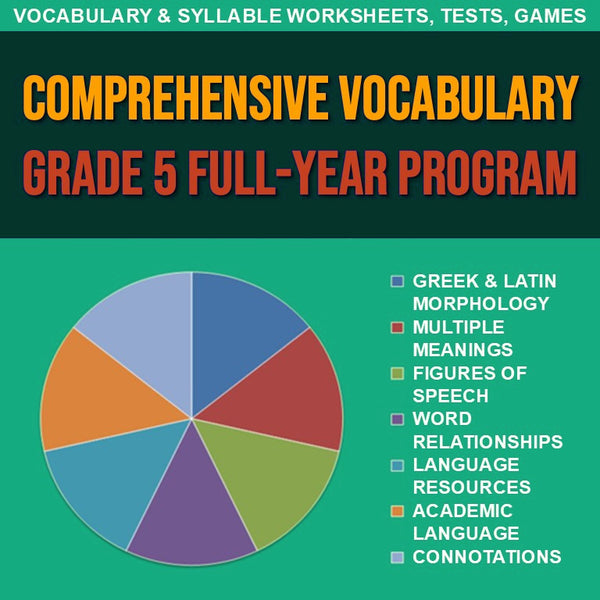
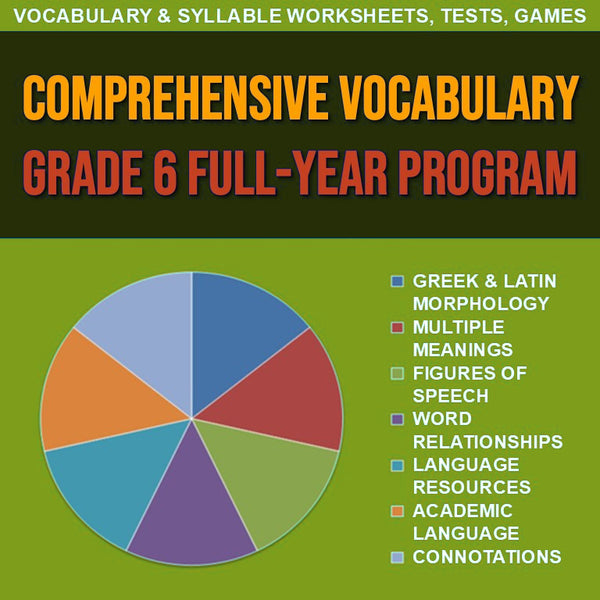
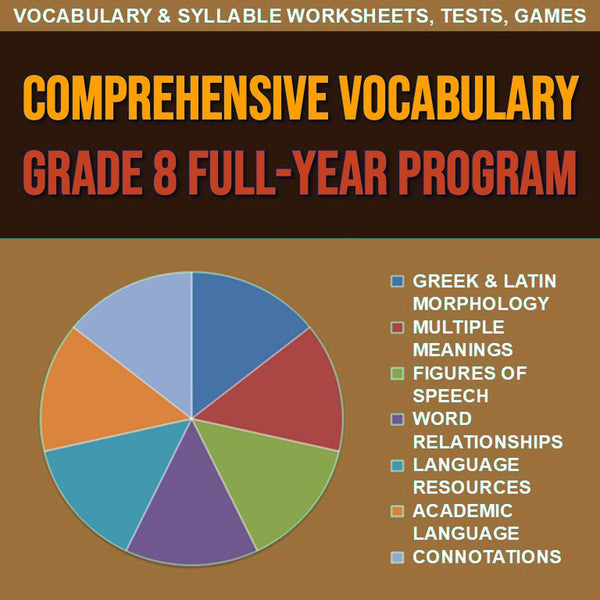
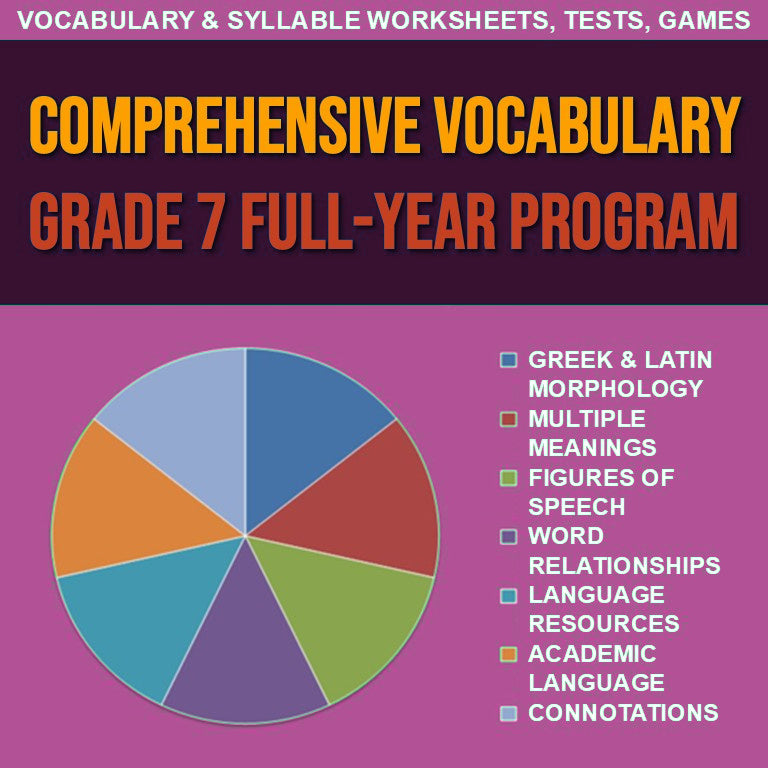
The Comprehensive Vocabulary Grade 7 program includes 56 lessons with plenty of practice, along with vocabulary study guides, biweekly unit tests, and a final exam. Worksheets include only the best vocabulary strategies: semantic spectrums, the Frayer model, context clue sentences, and more. The tests are provided in self-correcting Google forms and print formats. Lessons focus on the following components of vocabulary instruction:
- Multiple Meanings (L.4.a.)
- Greek and Latin Morphology (L.4.a.)
- Language Resources (L.4.c.d.)
- Figures of Speech (L.5.a.)
- Word Relationships (L.5.b.)
- Connotations (L.5.c.)
- Academic Language (Tier 2) Words (L.6.0)
All program components are digital downloads (no print books).
Click to HERE Preview the Entire Program
Here’s how your students will master each slice of the vocabulary pie:
Multiple Meanings
Students practice grade-level homonyms (same spelling and sound) in context clue sentences which show the different meanings and function (part of speech) for each word.
Greek and Latin Morphology
Three criteria were applied to choose the grade-level prefixes, bases, and suffixes:
1. Frequency research 2. Utility for grade-level Tier 2 words 3. Word Part Memory Pairs
Each odd-numbered vocabulary worksheet pairs a Greek or Latin prefix-base or base-suffix combination to enhance memorization and to demonstrate utility of the Greek and Latin word parts.
Language Resources
Students look up the Greek and Latin whole word in a dictionary (print or online) to compare and contrast their educated guesses to the denotative definition of the word. Students divide the vocabulary word into syl/la/bles, mark its primary áccent, list its part of speech, and write its primary definition.
Additionally, students write synonyms, antonyms, or inflected forms of the word, using either the dictionary or thesaurus (print or online). This activity helps students develop a more precise understanding of the word.
Figures of Speech
Students learn a variety of figures of speech (non-literal expression used by a certain group of people). The Standards assign specific types of figures of speech to each grade level. Students must interpret sentences which use the figures of speech on the biweekly unit tests.
Word Relationships
Students use context clue strategies to figure out the different meanings of homonyms in our Multiple Meaning Words section. In the Word Relationships section, students must apply context clues strategies to show the different meanings of word pairs. After students have mastered decoding, the program’s S.A.L.E. Context Clues Strategies will help students problem-solve the meanings of unknown words in their reading.
Students learn two new grade-level vocabulary words which have similar denotative meanings, but different connotative meanings. From the provided definitions, students write these new words on a semantic spectrum to fit in with two similar words, which most of your students will already know. For example, the two new words, abundant and scarce would fit in with the already known words, plentiful and rare in this semantic order: abundant–plentiful–scarce–rare.
Academic Language
Tier 2 words (academic vocabulary) should be a key focus of vocabulary instruction. The Academic Language section of the vocabulary lessons provides two grade-level words from the research-based Academic Word List. Students use the Frayer model four square (definition, synonym, antonym, and example-characteristic-picture) method to learn these words. The Common Core authors and reading specialists (like me) refer to this process as learning vocabulary with depth of instruction.
Vocabulary Study Guides
Vocabulary study guides are provided for each of the weekly paired lessons for whole-class review, vocabulary games, and individual practice. Print back-to-back and have students fold to study.
Vocabulary Tests
Biweekly vocabulary tests assess both memorization and application. The first section of each test is simple matching. The second section of each test requires students to apply the vocabulary in the writing context. Answers follow.
Syllable Blending, Syllable Worksheets, and Derivatives Worksheets
Whole class syllable blending “openers” will help your students learn the rules of structural analysis, including proper pronunciation, syllable division, accent placement, and derivatives. Each “opener” includes a Syllable Worksheet and a Derivatives Worksheet for individual practice. Answers follow.
Context Clues Strategies
Students learn the FP’S BAG SALE approach to learning the meanings of unknown words through surrounding context clues. Context clue worksheets will help students master the SALE Context Clue Strategies.
Vocabulary Acquisition and Use Resources
Greek and Latin word parts lists, vocabulary review games, vocabulary steps, and semantic spectrums provide additional vocabulary instructional resources.
Students who complete each of the Comprehensive Vocabulary Grades 4–8 grade-level programs will have practiced and learned much of the Academic Word Corpus and all of the skills of vocabulary acquisition. These students will have gained a comprehensive understanding of academic language and will be well-equipped to apply the skills of context clues strategies and structural analysis to read well and write with precision.
What teachers say
All reviews“It's a great resource that my students loved. Thank you!”
“Very comprehensive”
“Great product to help with vocabulary”
“Perfect for common core and academic vocabulary”
FAQ
Questions teachers ask
What is the Academic Language section?
Tier 2 academic words are a key focus, and each lesson provides two grade-level words from the research-based Academic Word List. Students learn them with the Frayer model four square of definition, synonym, antonym, and example, characteristic, or picture.
How many lessons and tests are there?
There are 56 lessons with practice, biweekly unit tests, and a final exam, plus vocabulary study guides for the weekly paired lessons.
What syllable work is included?
Whole class syllable blending openers teach the rules of structural analysis, including pronunciation, syllable division, accent placement, and derivatives. Each opener comes with a syllable worksheet and a derivatives worksheet for individual practice, with answers provided.
What extra resources come with the program?
Vocabulary acquisition and use resources include Greek and Latin word part lists, vocabulary review games, vocabulary steps, and semantic spectrums.
What format are the tests in?
The tests are provided in self-correcting Google Forms and in print. The first section of each test is matching and the second requires students to apply the words in writing.
Is a preview available?
Yes. You can preview the entire program free from the product page, and all components are digital downloads.